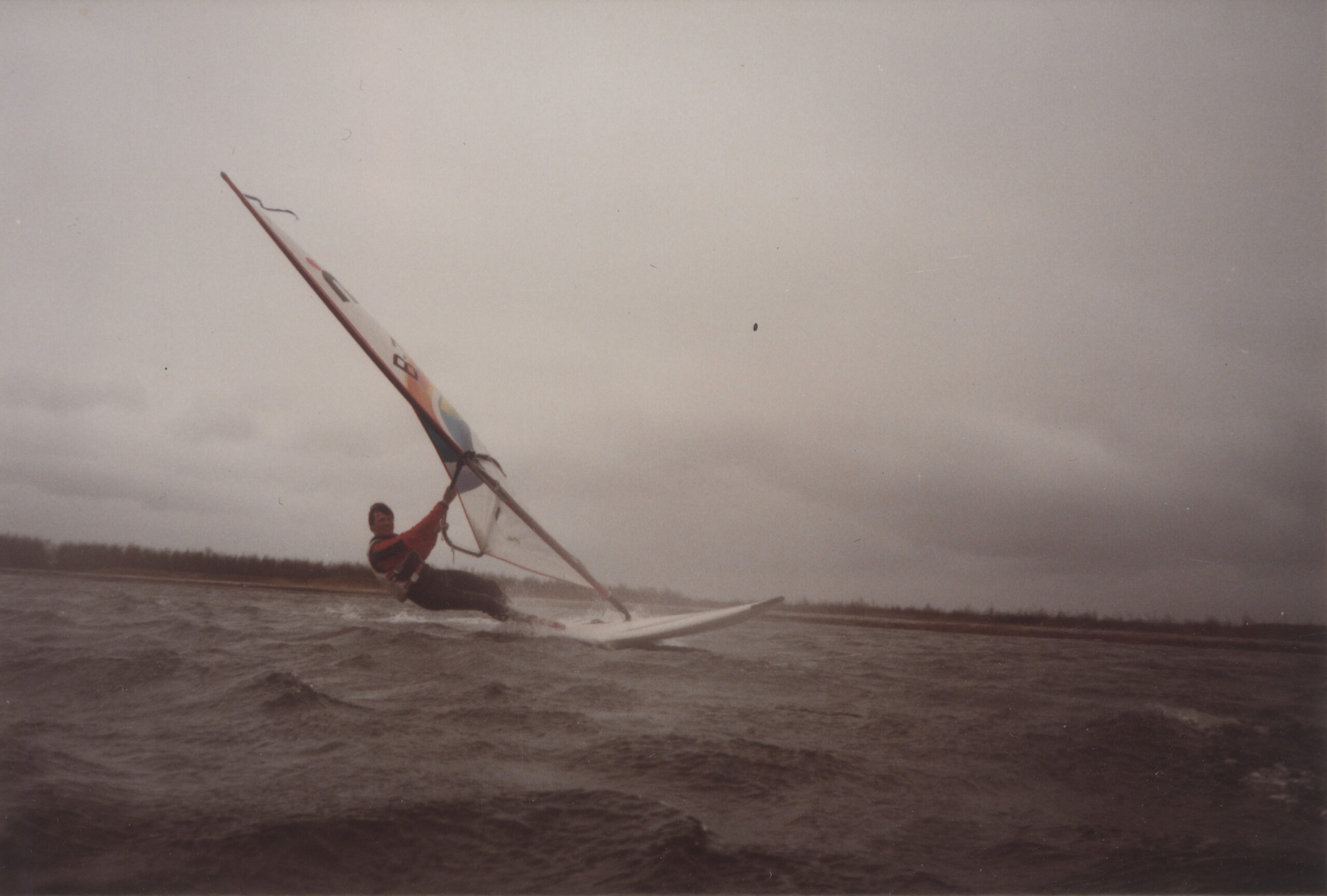

50 years ago, the first windsurf boards surfaced at Hotel La Réserve in Knokke-Heist. The renowned 5-star hotel thus wanted to offer an exclusive water sport to their clientele, who had had a taste of water-skiing on the same lake years before.
Christened the "Windsurfer", a concept patented by Messrs Hoyle Schweitzer and Jim Drake (USA) back in 1966. One was a surfer and the other a sailor, so they thought it would be fun to design a combination between the two. After several years of trial and error and the manufacture of several prototypes, the very first "windsurfer" rolled off the assembly line in 1970. A 25 kg polyethylene board with a wooden daggerboard in the middle, a plastic fin at the back, and a rig on top that was stretched with cords: the wooden mast foot was simply pushed into the board, with a mast on top of it over which the sail was slid, which in turn was stretched by an equally heavy teak boom, with which the surfer had to keep everything under control.
So were these new watercraft at Hotel La Reserve, where at first all they could do was ask our Norwegian neighbours how to get everything nicely rigged and even more: how to get ahead, turn and...stop it. The man in question was Gerard Moeken and since he could not welcome any customers in the beginning, he was forced to call on two teenagers who could be found in the water of the Zegemeer lake day after day... Tom Vandenbussche and Frank Vanleenhove each lived in their parents' house on the banks of the lake, had learned to swim there from their parents and were keen to get a chance to try out such a board...So no sooner said than done, and after a few trial and error attempts, they were both happily sailing back and forth on the Zegemeer after a while.
A good move as it turned out, because after the banks were initially populated with spectators, the clientele turned up in droves from then on. So much so that Tom (then 12 years old) and Frank (then 13) were called in daily to lend a hand and thus experience the holiday of a lifetime with the bonus of practising a new water sport to their hearts' content.
Neither of them could have suspected that their new passion would largely shape the rest of their lives: Tom later became "Chef de Planche à Voile" and travelled around the world with Club Med, and Frank threw himself into competitive surfing, becoming Belgian Champion in 1980 and co-founding the first real windsurfing club on the Belgian coast "Channel Surfing Club" in 1982 before then making work of the eventual Surfers Paradise on Knokke-Heist beach in 1988.
Get your all-time souvenir - our 50Y Tshirt: click here
Book your Windsurf BBQ for Surfer Joe's free concert

Booming Business
Needless to say, windsurfing has undergone a total metamorphosis since then. New brands and products popped up, and the sport only really became popular when it became clear that all the world's seas and oceans were also suitable for setting sail. New brands like Mistral, Bic, Alpha, Sailboard, Hifly, Dufour, Windglider, yes even our very own Browning, conquered the market and brought something for everyone. The triangular sail came off then in all shapes, sizes and colours and also the weight and size of the boards themselves were adapted to the user's wishes, and especially to the different weather and wind conditions. Especially during the 1980s, the sport reached unprecedented heights and hundreds of thousands of boards went over the counter worldwide.
Competitions were organised everywhere, different classes saw the light of day, and in 1884 Windsurfing became Olympic at the Los Angeles Games. The fence was completely blown when prodigy Robby Naish from Hawaii conquered the world with metre-high jumps, and riding metre-high waves on smaller boards. Windsurfing reached a new dimension, the competitions attracted tens of thousands of spectators and this new "funboard" trend once again created booming business, it was as if the sport had reinvented itself.
This technical (carbon) revolution meant that the price of equipment skyrocketed and the sport's image was also somewhat misjudged. You no longer really belonged if you reached the other side of the pond quietly unless you made meter-high jumps at sea in minimum wind force 6. An evolution that did the sport no favours because the learning process you have to go through is long and does not really fit that image.
Add to that the entry of kitesurfing in 1999: easier to learn and less wind required and you know that from the 2000s onwards, a downward windsurfing trend was the result.
As for the factories, fortunately by now there were windsurfing centres all over the world in the windiest locations, offering all visitors top-notch equipment every year. A blessing for the airlines, who by now had had enough of lugging heavy boardbags around.
read more: 50 years of Windsurfing in Belgium
Read also: Half a century of windsurfing in Knokke-Heist: the local story



 Nederlands (België)
  Français
  English (UK)
  Deutsch